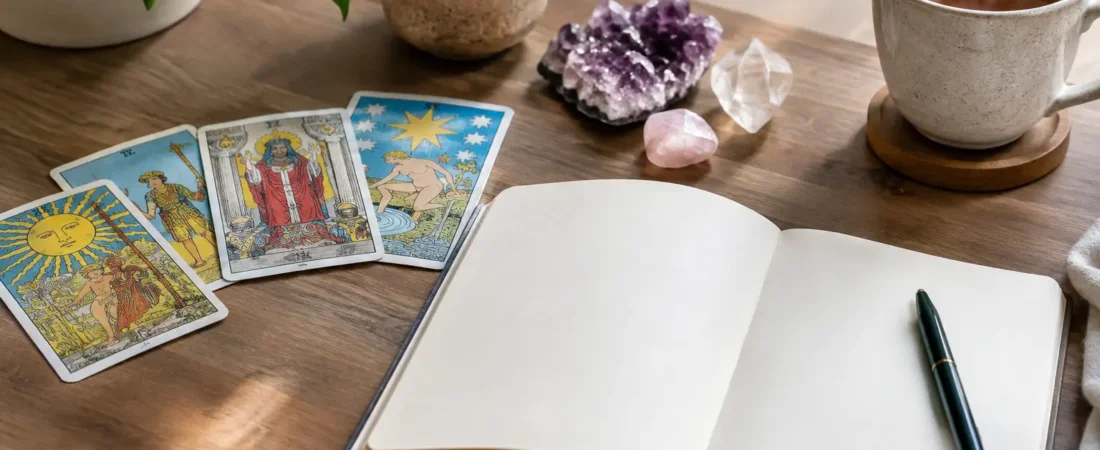
A tarot reading can feel deeply clear in the moment, then become blurry once life, emotions, and other people’s opinions rush back in. Tarot journaling methods give your reading somewhere to land. They help you hold onto the message, notice patterns over time, and turn intuitive insight into a grounded next step.
You do not need beautiful handwriting, a perfect notebook, or advanced knowledge of every card. Your journal is a private place to be honest about what you are feeling, what you fear, and what you truly hope for. Think of it less as a record of predictions and more as an ongoing conversation with yourself and your intuition.
Why journal after a tarot pull?
A single card can mean different things depending on the question, the surrounding cards, and the season of life you are in. The Five of Cups may reflect grief after a breakup, disappointment around a job opportunity, or the habit of focusing on what went wrong while overlooking support that is still available. Writing down your first response gives the card personal context.
Over weeks and months, your journal can also reveal what a one-time reading cannot. You may notice that the Two of Swords appears whenever you avoid a difficult conversation, or that the Queen of Pentacles comes up when you are being asked to care for your finances and your own needs. Those repetitions are not meant to frighten you. They can gently point toward the places that deserve your attention.
Tarot is guidance, not a command. A journal helps you stay in that healthy, empowered relationship with the cards. You are always allowed to reflect, choose, change direction, and seek practical support when you need it.
1. The simple daily card method
This is one of the easiest tarot journaling methods for beginners and busy people. Pull one card in the morning, or at the end of the day, and write the date, the card’s name, and your immediate feeling about it. Before reaching for a guidebook, ask yourself what detail in the image catches your attention first.
Then write a few sentences in response to three gentle prompts: What energy does this card invite me to notice today? Where is this already showing up in my life? What small action would honor this message?
A daily pull does not have to predict the events ahead. If you pull the Knight of Wands, for example, the message may be to act with courage, speak up, or use your excitement wisely instead of rushing. At night, add a short note about what actually happened. This is how you begin to understand your own relationship with the cards instead of trying to memorize meanings alone.
2. The question, cards, and feelings method
When a concern is weighing heavily on you, it helps to separate the reading from the emotional storm around it. Start by writing your question exactly as you mean it. Clear questions tend to create clearer reflections.
Instead of asking, “Will they come back?” you might ask, “What do I need to understand about this connection right now?” If you are considering a career move, try, “What should I consider before accepting this opportunity?” These questions keep your power at the center of the reading.
After laying out your cards, record the card positions and traditional meanings that feel relevant. Then add a separate section called “My feelings.” Be direct. Maybe the Three of Swords makes you sad because the relationship ended painfully. Maybe the Ace of Cups brings relief because part of you is ready to begin again.
This distinction matters. Your emotional response is valuable information, but it is not always the full message of the reading. Seeing both on the page can bring compassion and perspective when you feel overwhelmed.
3. The three-part clarity spread
Some situations do not need a large, complicated spread. A three-card reading can offer a calm structure when you are stuck between options or cannot see the path ahead. Pull cards for: what is true now, what needs your attention, and the most supportive next step.
Journal each card under its position, then look for the story connecting them. Suppose you are feeling uncertain at work and pull the Eight of Pentacles for what is true now, the Seven of Cups for what needs attention, and the Emperor for the next step. You might see that you have real skills and effort behind you, but too many possibilities are scattering your focus. The next step could be to create a plan, set a boundary, or ask a practical question instead of waiting for certainty to appear.
End this entry by naming one action you can take within a week. Tarot guidance becomes more useful when it is paired with a choice you can actually make.
4. The relationship reflection method
Love readings can bring up hope, longing, anger, and vulnerability all at once. That is exactly why journaling is helpful. Rather than pulling cards repeatedly for reassurance, use the journal to ask what the connection is teaching you about your needs, patterns, and boundaries.
You might draw three cards with the questions: What am I bringing into this relationship? What is this connection asking me to learn? How can I care for myself regardless of the outcome? Write without editing yourself. If you realize you have been waiting for someone else to give clarity they are unwilling to give, that realization may be painful, but it can also be freeing.
This method is not about judging yourself or the other person. It is about returning to your own emotional truth. Healthy love includes communication, consistency, and mutual effort. Tarot can reflect the energy around a situation, but your journal can remind you what you deserve in real life.
5. The shadow and healing method
Some cards touch tender places. The Devil, Nine of Swords, Tower, and Death can make people nervous, yet they often open a powerful space for healing. Do not force yourself into deep emotional work on a day when you feel raw. But when you have the capacity, try writing with curiosity rather than fear.
Ask: What part of myself is asking to be seen? What belief or pattern may be keeping me stuck? What support would help me move through this with care?
The goal is not to turn every difficult card into a positive one. Sometimes a hard card simply validates that a situation has been hard. Let that truth be enough before you search for a lesson. If your journaling brings up intense distress, reach out to someone you trust or a qualified mental health professional. Spiritual reflection and practical care can stand side by side.
6. The recurring card tracker
Reserve a few pages in the back of your journal for cards that appear repeatedly. Each time a card returns, write the date, the question, and a sentence about what was happening in your life. You do not need to track every card forever. Focus on the ones that seem to follow you.
A recurring card may change meaning as you change. The Hermit might first appear during loneliness, then later represent healthy solitude and a stronger inner voice. The Wheel of Fortune may show up during a period of uncertainty, reminding you that conditions can shift and that you are not trapped in one chapter forever.
This method builds trust in your own observations. You may find a meaning that is personal to you while still respecting the card’s traditional symbolism.
7. The reading follow-up method
A tarot journal is most meaningful when you return to it. Choose one reading each week or month and revisit it after some time has passed. Under the original entry, write what unfolded, what you understand differently now, and whether you followed through on your intended action.
Be kind with yourself if the reading did not make sense right away. Some messages become clearer only after you have lived through the situation. Other times, you may realize you interpreted a card through fear rather than intuition. That is not failure. It is part of learning to listen more honestly.
If you receive a personal reading and feel a strong message afterward, journaling can help you carry that clarity beyond the session. At Tarot Readings by Lyman Holton, the purpose of guidance is not to leave you dependent on the cards. It is to help you feel more centered, informed, and supported as you make your own decisions.
Choose the method that feels manageable today. One honest paragraph after a single card can be more healing than pages of forced interpretation. Let the journal be a place where you meet yourself with the same patience, truth, and compassion you are seeking from the cards.
Leave a Reply
You must be logged in to post a comment.