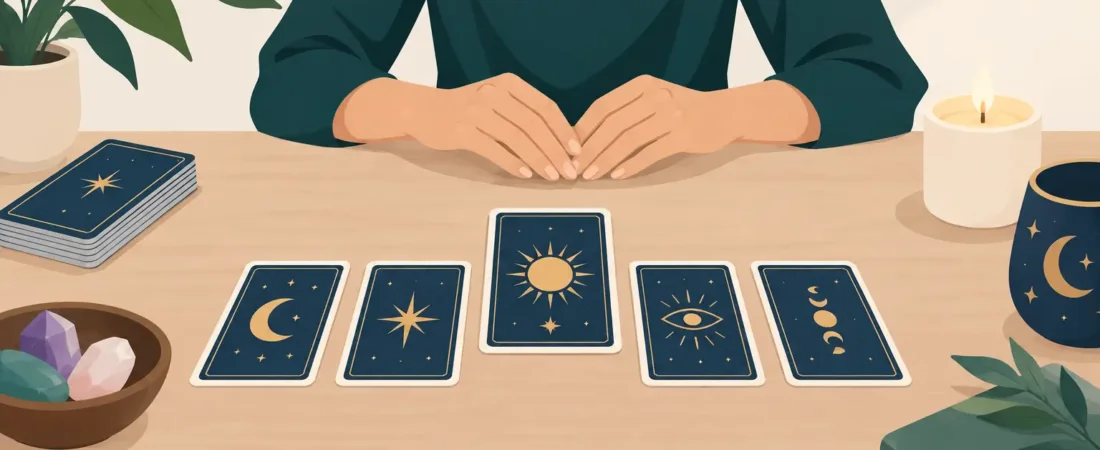
A tarot reading does not have to begin with a complicated 10-card layout or a perfect knowledge of every symbol. The most helpful beginner tarot spreads often use just one to three cards, giving you room to listen to your own intuition while staying focused on the question in front of you. When life feels uncertain, a simple spread can bring a calm, honest perspective to what you are feeling and what may deserve your attention.
Tarot is not here to take away your free will or make choices for you. It is a spiritual tool for reflection, insight, and seeing a situation from an angle you may have missed. Whether your question is about love, a job change, family tension, or a decision that has been weighing on your heart, starting small can make the cards feel much more approachable.
How to Begin a Tarot Reading With Confidence
Before you shuffle, take a moment to settle yourself. You do not need candles, a special table, or a memorized ritual, although those things can be comforting if they are meaningful to you. A quiet place, a clear question, and a few undisturbed minutes are enough.
Try asking an open question rather than demanding a fixed prediction. Instead of asking, “Will my ex come back?” you might ask, “What do I need to understand about this connection right now?” Instead of, “Will I get the job?” ask, “What energy surrounds this career opportunity, and what can I do to prepare?” Open questions leave room for guidance that is practical as well as spiritual.
As you look at each card, notice your first reaction. What detail stands out? Does the image feel hopeful, tense, familiar, or surprising? Traditional card meanings give you a strong foundation, but the context of your question and your honest emotional response matter too. A card that seems difficult is not a punishment. It may be asking you to slow down, tell yourself the truth, or choose a healthier path.
Beginner Tarot Spreads That Keep Things Simple
The one-card daily guidance spread
The one-card spread is one of the best places to start because it teaches you to build a relationship with your deck without becoming overwhelmed. Shuffle while asking, “What guidance would support me today?” Then pull one card.
You may receive a card such as the Four of Swords, which could suggest rest, reflection, or a need to step back from stress. The Queen of Wands might encourage you to speak up, be visible, or trust your abilities. If you pull the Five of Cups, do not assume the day is doomed. It may simply acknowledge grief or disappointment that needs gentle care.
Keep a small journal of your daily cards. Write down the card, your first impression, and what happens during the day. Over time, you will begin to recognize how the cards speak through patterns, feelings, and real-life situations.
The three-card past, present, future spread
This classic spread is popular for good reason. It gives a clear story without requiring you to interpret too many cards at once. Place three cards from left to right: past, present, and future.
The past card can reveal an experience, belief, or emotional pattern that still influences the situation. The present card shows what is most active now. The future card points toward a likely direction if the current energy continues. It is not a permanent sentence. Your actions, choices, and conversations can change the road ahead.
This spread works well for general questions, but it can be especially useful when you feel stuck in a repeating relationship pattern. You may see where old hurt is still shaping present expectations and what kind of healing or boundary could support a different outcome.
The situation, challenge, advice spread
When you need a grounded answer, this three-card layout can be very direct. The first card represents the situation. The second shows the challenge, hidden influence, or obstacle. The third offers advice for moving forward.
Imagine you are considering whether to stay in a job that no longer feels fulfilling. The first card may reflect burnout or a desire for more meaning. The challenge card could show fear of change, financial pressure, or a lack of confidence. The advice card might encourage planning, patience, honest communication, or taking a practical first step.
The value of this spread is that it does not pretend every problem has an instant answer. Sometimes the cards show that you need more information before deciding. Sometimes they reveal that the challenge is not the outside situation but the fear you carry into it. Both are valuable insights.
The relationship clarity spread
Love questions can bring up strong emotions, especially when communication is unclear or a connection feels unbalanced. For a simple relationship reading, pull three cards: your energy, the other person’s energy, and the energy between you.
This spread is not meant to invade someone else’s privacy or prove exactly what another person is thinking. Rather, it helps you understand the dynamic. You may see that you are holding tightly to hope while the connection itself calls for a more honest conversation. You may also see mutual care alongside timing issues, misunderstandings, or emotional walls.
If the cards feel painful, return to what you can control: your boundaries, your communication, your self-respect, and the kind of love you are willing to accept. Tarot can offer comfort, but it is most empowering when it brings you back to your own center.
The decision-making spread
When two options are pulling at you, use four cards: what supports option A, what challenges option A, what supports option B, and what challenges option B. This is useful for career choices, moves, creative projects, or deciding how to approach a difficult family matter.
Avoid asking the cards to declare one path absolutely right and the other absolutely wrong. Most meaningful choices involve trade-offs. One option may offer security but feel limiting. Another may feel exciting but require patience, preparation, or a willingness to face uncertainty. The spread can help you see those trade-offs clearly enough to make a choice that fits your values.
What to Do When a Card Feels Scary
Many new readers worry about pulling cards like Death, the Tower, or the Devil. These cards can be intense, but they are not automatic signs of disaster. Death often speaks of endings, release, and transformation. The Tower can reveal a truth that breaks through denial or a structure that can no longer hold. The Devil may point to fear, unhealthy attachment, shame, or a pattern that has more power over you than it should.
Read challenging cards with compassion. Ask what needs to change, what needs to be faced, and what support would help you move through the moment. If a reading leaves you feeling deeply distressed, step away from the deck, ground yourself, and speak with someone you trust. Tarot is a source of guidance, not a replacement for professional medical, legal, financial, or mental health support.
Let Your Practice Be Personal
There is no prize for reading the most cards or memorizing every meaning immediately. Some people connect deeply with imagery and intuitive impressions. Others prefer learning the traditional symbolism first. Both approaches are valid, and most readers eventually blend them.
Give yourself permission to use the spreads that genuinely help. A one-card pull may be enough on an emotionally heavy day. A three-card reading may offer more perspective when you are deciding whether to have a difficult conversation. The cards are most useful when they help you feel more honest, more steady, and more connected to your own inner wisdom.
Start with one question that matters to you, shuffle with an open heart, and let the message unfold one card at a time.
Leave a Reply
You must be logged in to post a comment.